Monday, December 6, 2010

5 Questions with Lerzan Aksoy and Timothy Keiningham, authors of Why Loyalty Matters


1. Why does loyalty matter so much?

Loyalty matters in all aspects of our lives because everything we hope to accomplish,
our dreams, our goals, whether personal and professional is going to be with and through
other people. We need each other! To get what we want in life and to be happy…
Loyalty is the glue that binds these relationships. Without loyalty our relationships
become mere acquaintances and lack the sort of depth that we need as humans to
fulfill us. This is not to say that all our relationships have to be based on loyalty but we
definitely need some!

2. What's the best example of how loyalty matters in the book?

The best example of loyalty in the book is one in the chapter is about the friendship
between Frank Sinatra and his fellow rat packer Sammy Davis Jr. When Sinatra could
no longer bear Davis’s drug use, he acted out of true loyalty and love by confronting
Sammy. “Look,’ Sinatra said, ‘God put you here for a lot of reasons that you and I don’t
even know about. He gave you a talent, and you’re abusing it. And I’m watching my
friends go down the tubes. I loved you when you were nothing. I’ll love you when you
go back to being nothing. But you’re cheating yourself. You’re cheating your public and
as long as you’re going to do that then I don’t want to be around you.’ Sammy heard
Frank’s message and he kept his word to quit drugs. Loyalty to a friend sometimes
means letting go. It means being loyal to their highest and best self as well.

3. What's a good way to instantly build loyalty with someone?

We all wish this could happen instantly. But unfortunately this rarely happens. Just
as trust takes time to build, so does loyalty! The important point here is that you have
to keep working at it and dedicating time and effort to your relationships. Ironically,
our research shows that most people do not spend the time and effort to build these
relationships.

4. How has loyalty improved your work life?

Loyalty in the workplace is just as important as loyalty in our personal lives. By building
loyal relationships in the workplace we become surrounded by a group of engaged
colleagues who are productive, who dedicate themselves to the job, who are ready to do
work above and beyond what is necessary and who feel a strong connection to the team
that they work with. This provides for a workplace with happier and more fulfilled people
at their jobs who don’t merely see it as a way to make money and are ready to give 110%.

5. What's next for yourself?

Loyalty is our passion and we would like to continue on this path for future work. We
truly enjoy being in the loyalty space because we get to show how it’s good business to
be good to one another!

5 Questions with Lou Jacobs, author of The Art of Posing


How can one master the art of posing?

Posing skill grows with experience. Your own personality reaches out to subjects. During a portrait session a subject tends to move frequently between shots, and successful images depend on friendly rapport and your ability to say “stop right there,”to get great poses. Being able to recognize poses the client will like includes shooting some that you will discard before you show the full take. Success also depends on enjoying portraiture and having empathy with the man, woman or child you see in the camera finder.

How did this book come about?

I have written a number of books for Amherst Media for more than a decade, and sometimes I suggest a topic, and other times my publisher, Craig Alesse, comes up with a subject he feels would fit into the many titles the company lists on its website. The Art of Posing was Craig’s idea, and I learned a lot more about posing as I worked with the 10 talented photographers whose pictures are featured.

What’s the man theme in this book?

It’s that you can’t take posing for granted. The subject of a portrait may fall into terrific poses spontaneously, and that’s a blessing, but there are many people who freeze in front of a camera. The way you cajole reluctant clients leads to successful pictures that both you and the person(s) like- and pay for. 

How can one improve their photogenic-ness?

All egos are not equal, so some sitters are quite at ease and give you wonderful expressions easily, and some need to be directed. Classy photographers know how to flatter people without sounding phony, and they also know how to see and capture the best expressions and poses, the ones that most people love. One doesn’t have to be greatly photogenic to have angles that the camera enhances to make clients surprised about how attractive they look.

What’s next for me?

Like an actor who is between pictures, I’m an author between books at the moment. I may be writing a new book on photographing children, but my publisher and I are still choosing a topic. I have written 37 how-to photography books in my long career, and I like finding new approaches to tackle.

Thursday, December 2, 2010

5 Questions with Ted Hunt, author of BEN HOGAN’S SHORT GAME SIMPLIFIED


What’s the best tip in this book?


That would be:  DO NOT RELY on ‘tips’ to improve your game, because they are like band-aids and fall away pretty quickly.  95% of amateur golfers need a SYSTEM . . . and Ben Hogan provides this, par excellence, for those who are willing to do a little work: i.e. fifteen minutes a day for seven days.  You learn his system over the week, and ingrain it; and suddenly you have great consistency and new control. My putting average went from 33 per round to 27.  They used to call me ‘the 142nd best chipper in the club (like “the 142nd fastest gun in all the West.”  Now they argue if I’m 1st or 2nd best.

What can someone easily do to improve their short game?


Learn to use what Hogan playfully called his ‘Magical Device’ so that the club head meets the gall crisply time after time.  (That’s why Mr. Hogan’s clubs had a well-worn shiny mark, like a dime, on the sweet-spot.)  And this mark was the product of mechanics, not luck. Unfortunately, Mr. Hogan knew how to contact the ball properly, but having virtually dropped out of school in grade 10, he did not have the education to properly use the anatomical terms his artist/illustrator friend used from his anatomy background. (more unfortunate coincidence.)  Anthony Ravielli did not know enough about golf to correct Hogan, the master, and so Hogan’s heralded description of his swing in The Five Lessons created chaos, as people tried to apply these incorrectly used directions which focussed on pronation and supination of the hands -- which as you will learn, was exactly what Hogan DID NOT DO.
I was able to talk at length to Stan leonard, Moe Norman and George Knudson about what Hogan did to apply “his secret” and put their slang language into understandable universal terms.  

What’s the most common problems newcomers make?


    I am not sure of the ‘most common‘ mistake, but I know the most ‘ruinous‘ one:
    That is, the uninitiated golfer ‘breaks down‘ his lead hand at impact, hoping for ‘perfect timing‘ which happens just often enough, to make it hard to convince them to spend one week -- 15 minutes a day, to get it right.  Over a week you can ingrain it and have it on hand for the rest of your golfing days.  (Read the story in ‘Ben Hogan’s Magical Device’ about the last three balls he hit in his 82nd year.)

    What was special about Ben Hogan?


    His determination.  Ben Hogan got so tired of not knowing where the ball was going, that he spent four years, twelve hours a day, in trial and error experimentation to develop his special system so that he could take his impact technique for putting and chipping into long chips, pitches, lobs, half-shots, to the full shot.  With a five foot eight body at 140 pounds, he became not only one of the longest hitters in the game, but also the straightest.  Although his injured left eye degenerated with age, earning him a reputation for poor putting, he was in fact, the most consistent putter on tour -- many times playing major championships without a single three-putt on those slippery championship greens. You will learn to climb the staircase for the ten stages of his swing to the full shot.  You will learn all the parts of the ‘impact-zone’ technique with putting and short chips for one week; then you are ready to climb the staircase which is 55% of our game.

    What’s next for you?

      I’ve been invited to Augusta this Spring to watch the Master’s.  Up to that delightful point, I will continue to nag/cajole/insist that friends who have purchased the two Hogan books will follow his basic formula -- start with 30 short putts (5 feet) to a tee on the putting green -- no holes -- very bad psychology -- or a dime on your carpet; then 30 short (12 feet) chips  . . . both for 7 days.  For homework, watch your form at home in front of a mirror and critique your form (eg.)  No movement below the waist, and your hands DO NOT MOVE . . .the magical device moves them for you. After one week you’re ready for section 2 of Hogan’s swing -- long putts (which will involve a change below the waist.  By the end of the 2nd week you will be a changed golfer in:  short chips and putts, long chips and long putts, pitches and lobs, and should very quickly pick up on half-shots and three-quarter shots. After a week and a half, I broke my age by three strokes.  After three weeks I began a streak of breaking my age nine times in competition.   (The sale of the book went up at my club)
      All best for the enjoyment of this challenging game.

      Wednesday, December 1, 2010

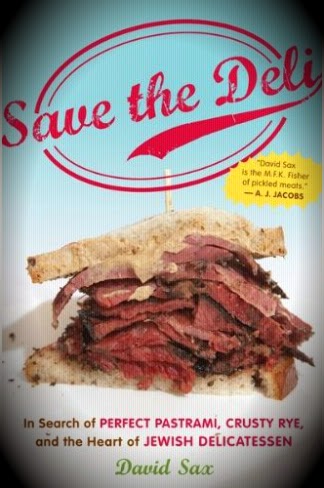
      5 Questions with David Sax, author of Save the Deli


      For those who haven't heard, what's the book about?

      Save the Deli is an in-depth look into the history, culture, and personalities behind the Jewish delicatessen business around the world.  It's also a call to arms, as it were, because the Jewish delicatessen has been disappearing for almost a century, and I'm arguing essentially why we should care, fight for its survival, and eat more deli.

      What'd you learn from your journey?

      At least 320 pages worth of stuff!  But I'd say that no matter where the deli was, whether it was Paris, or Salt Lake City, or New York, the owners all had a common experience, faced common problems, served common foods, and dealt with similar customers.  Though geography and local culture left their imprint, the Jewish deli is like the Jewish experience in the Diaspora...distinct in some ways, but incredibly close in many others.  

      What's the best deli in Toronto?

      I don't have one favorite, but many.  I grew up at Yitz's and Centre Street, love Moe Pancer's and Wolfie's, and because I live downtown, spend a good amount of time at Caplansky's.  

      What's the most interesting deli you've been to?

      Probably Maison David in Paris.  It's just a tiny butcher shop, but the owner, Michel Kalifa, makes the most incredible kosher meats and sausages that just blow your mind.  

      What's next for you?

      Many many sit-ups. 

      5 Questions with Dr. Shefali Tsabary, author of "The Conscious Parent"


      What is a key component of being a conscious parent?

      Becoming a conscious parent is realizing that in order to raise our children well we need tofirst raise ourselves into more connected and spiritually evolved beings. Our children are able to kindle this awakening within us but we are often unable to answer this call.  
       
      How can one empower their children without letting them get too out of control?

      When we understand that there are two aspects to their development, their essence and their ego, we will be better able to undertake this delicate dance. When we connect with our children’s essence and truly develop a soul partnership with their inner being, we are able to effortlessly empower them at a deep and fundamental level. When they act-out and are defiant, we then understand this to be a manifestation of their ego, not their essence. It is our task as parents to teach them to attune to their essence not their ego. In order to do this then, we need to help them contain their ego.Teaching them to “not get too out of control” is a natural element of conscious parent and emerges directly from the
      relationship we share with them.

      What did it mean to have Eckart Tolle endorse the book?
      To have Eckhart Tolle endorse the book was a blessing indeed! His ability to understand the workings of the ego are pivotal for all of us as we try to free ourselves from its snares and engage with a more awakened state of living and relating.
      What's the most intriguing chapter in the book for yourself?
      I think there are many places in the book where the focus is on this relationship between the ego and the essence. I particularly focus on this relationship because it is here that we get stuck in our own lives and with our children. Understanding the manifestations of both is a key component to awareness and greater inner fulfillment.

      You mention anxiety is a form of doing. What does that mean?
      Anxiety occurs when our mind resists the current situation. It is because we resist the present situation in its as-is form, we feel we need to change it in some form or another. Sometimes we are able to make this change. Yet, at other times this change is difficult. We react to this difficulty from within. A typical way to react to this is through anxiety. It feels as if we are “doing” something
      - as we cannot physically change it so we seek to control it in order ways: worry, obsessions, over-intellectualization, etc. In these ways we feel greater control over our ever-shifting realities. To engage with our present moments in the now is often too daunting. So we react. Anxiety is the most typical reaction.

      5 Questions with Scott Hibbard, author of Religious Politics and Secular States


      1. What inspired this book?

      The initial impetus for the book emerged in the mid-1990’s, when I was working in the Special Initiative on Religion, Ethics and Human Rights at the U.S. Institute of Peace.  During that period, the Egyptian government was in the process of defeating an Islamist militant insurgency.  At the same time, however, books and films were being banned by Islamic censors within the Egyptian government, and a variety of secular intellectuals were being tried in Egyptian courts for apostasy.  The most notable case was that of Nasr Hamid Abu Zayed, but there were others, such as Sayed al-Qumni and Said Ashmawy.  The question in my mind, then, was why the government was winning the battles against insurgent Islamic groups, and yet losing the war?  It was this paradox that prompted my initial research.

      On a deeper level, the inspiration ultimately derives from the fact that I am enormously interested in religion and politics.  I remember vividly my mother’s political activism in the 1960’s and 1970s, and how this was very much intertwined with our Church (which was a non-denominational liberal Protestant church in West Michigan).  In that arena, the fault lines of political conflict on a host of issues – abortion, the environment, etc – were not along class lines, but between different religious denominations (or, more specifically, between different churches).  The main argument of book, in many respects, flows from this basic insight: the fault lines of political conflict often reflect the religious divisions within a given society.

      2. What common elements do the US, India and Egypt have when it comes to religious politics?

      There are several commonalities discussed in the book, of which I will touch on three.  The first is the association of religion and nationalism, and how different interpretations of religion inform differing conceptions of national identity.  In other words, all nationalisms are defined by a high degree of malleability, and typically pit inclusive  – or civic – conceptions of national identity against exclusive – or ethnic – conceptions.  Moreover, differing interpretations of religion, such as modernist and fundamentalism (or what I describe in the book as “liberal” and “illiberal”), inform these competing visions of nationalism and identity.  

      This, then, ties into the second issue: the secular legacy.  During the 1950’s and 1960’s, these three countries were the quintessential examples of secular modernity: Nasser’s Egypt, Nehru’s India and Kennedy’s America.  And, yet, all three cases subsequently witness the rise of chauvinistic religious (or fundamentalist) movements.  The book focuses, then, on explaining why that is the case.  A key part of this narrative is how modernist (or liberal) interpretations of religion helped to inform the secular consensus of the post-WWII era.  Secularism in this sense was an issue of state neutrality in matters of religion, not hostility to religion.

      The third commonality is the way in which the secular legacy was displaced in all three countries.  As I argue in the book, state actors were key defenders of the secular order in the 1950s and 1960s.  This changed, however, in the 1970s and 1980s.  During this latter period, fundamentalist, or theologically conservative, interpretations of religion were invoked by state actors to sanction a new era of conservative politics.  This shift reflected a new era of right-wing populism, which helps to explain the demise of the secular order.  In other words, the changing attitude of mainstream political leaders towards exclusive conceptions of religion and society helps to explain the ideological transformation in each case.  It is not that the secular was overthrown, as much as it was abandoned.


      3. How has the book been received?

      To date, I have received positive feedback, both from external reviewers and from the various talks that I have given on the book (both pre-publication and post-publication).  It definitely fills a niche, in part because of its emphasis upon the instrumental manipulation of religion – and the interactive nature of religious politics – which are key differences from other, related studies.

      4. What was the most interesting part about writing the book?

      The most interesting part of writing this book was clearly the field work.  I spent a fair bit of time living and researching in Egypt (in 2000 and 2002), and in India (2003).  During that period, I conducted interviews with a variety of political actors, journalists, academics and opposition political party members.  In India, I also engaged in extensive archival research, though I did interviews there as well.  The individuals with whom I met, the opportunity to live overseas, and the overall experience was truly formative.  It also provided a unique insight into the countries in question.  

      5. What's next for you?

      I am currently working on book chapters for two separate edited volumes on the topic of religion and politics, and am co-editing a book on Islamic thought and politics with two colleagues.  When these projects are completed, I plan to write a book on Islamic politics and American foreign policy. 

      5 Questions with Nina Dubin, Author of Eighteenth-Century Paris and The Art of Hubert Robert


      For those who don't know, what's the book about?

      On the surface, the book’s about an eighteenth-century French artist who was hugely successful in his day as a painter of ruins. But in a sense, it’s also a book about the present. Art historians generally associate the eighteenth-century love of ruins with the period’s archaeological discoveries and its veneration of ancient Rome. But what the book argues is that the cultural obsession with all things ruinous came about with the dawning of the age of financial uncertainty. The main focus is on a series of Robert’s paintings featuring spectacular scenes of destruction—fires and demolitions, real and imagined. It interprets these within the contexts of real estate speculation in Paris, a volatile stock exchange, and the fluctuations of credit, among others: that is, within a climate of widespread gambling on the future. 


      What was special about Hubert Robert?

      I think he had a special, unmatched capacity for generating sublime, awe-inducing subjects. What he lacked in the way of skill he made up for conceptually, producing impossibly massive, often mystery-filled architectural landscapes. He’s also quite interesting biographically. He had his finger in just about every pie in the cultural buffet: beyond outfitting the homes of the wealthy with his fantastical views of ruins, he built a reputation as a leading designer of gardens at a time when countryside estates were all the rage; he also was one of the first curators at the Louvre. Another remarkable thing about him is that rather than leave Paris during the tumult of the French Revolution—despite that fact that his patrons were fleeing or facing death sentences—he chose to stay, turning down Catherine the Great’s invitation to work for her in St. Petersburg as court artist; consequently he spent eight months in prison and narrowly escaped the guillotine. 


      How did he influence the world of art?

      In the most immediate way, he spent eleven years in Rome building up a repertory of ruin motifs which were mined by neoclassical artists and architects—most famously BoullĂ©e and Ledoux—back in Paris. But one can speculate that traces of his paintings—particularly those featuring urban disasters—reside in more recent art as well. For instance, he and the Chinese artist Cai Guo-Qiang—who orchestrates large-scale, pyrotechnic “explosion events” involving gunpowder—might be thought of as bookending the risk-courting artistic tradition, with Turner in that trajectory as well.     


      Which one of his works struck the biggest chord with you?

      I have a soft spot for a gigantic work at the Los Angeles County Museum of Art that epitomizes his nack for architectural drama: it features skyscraper-like fountains and trees, and miniscule figures wandering a vast, endless staircase that leads to some ambiguous destination. Other chord-strikers: his 1796 pendant paintings of the Grand Gallery of the Louvre museum while it was still undergoing renovation. The first view shows the gallery as it will look upon its completion; the second imagines the same scene in a future state of ruin. A few years later, the artist Joseph Gandy followed Robert’s lead and produced two views of the newly completed Bank of England—the first in its renovated state, and the second as a dilapidated structure. Together, these fascinating and enigmatic works point to the ways in which ruins stirred ideas of the past and future alike.  


      What's next for you?

      At the moment, I’m working on a project on prints of ruins produced in Revolution-era Europe; I’m also interested in writing a history of the relationship of art and finance from the eighteenth century to the present.